
Account-Based Marketing is a long-term play, until a deal moment changes everything.
When an RFP lands, buying groups expand, timelines compress, and internal deal teams suddenly grow. Without a shared account narrative, the customer experience risks fragmenting just when alignment matters most.
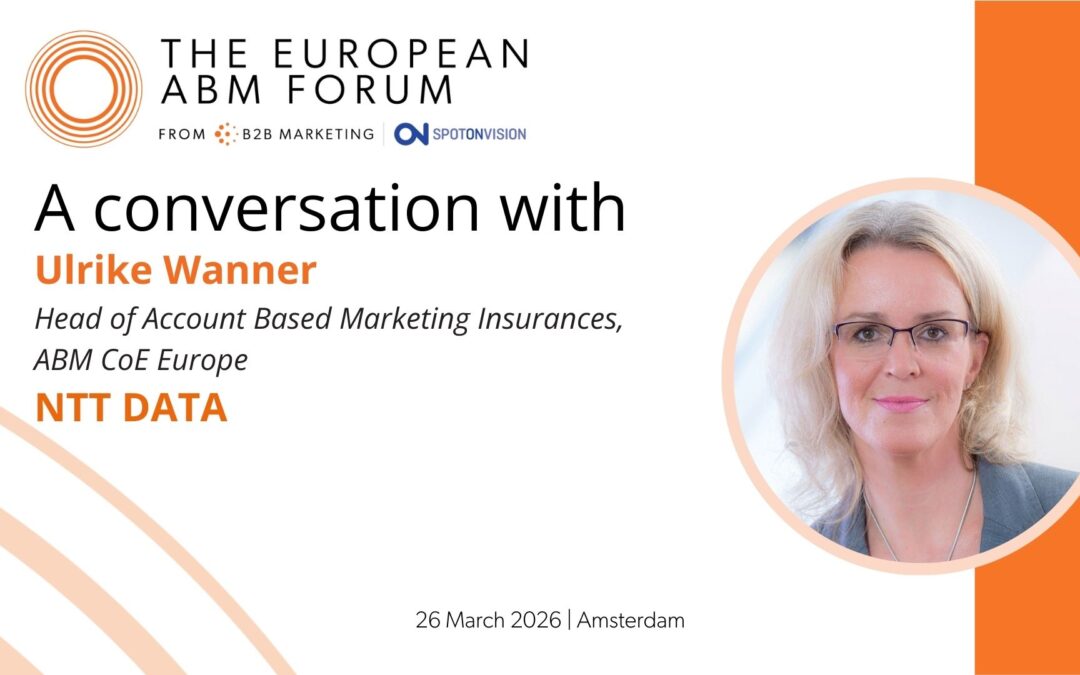
In a recent conversation with Ulrike Wanner (NTT DATA), we explored exactly this challenge. Ahead of her session “Resilience Redefined” at the European ABM Forum (Amsterdam, 26 March 2026), Ulrike shared a practical framework for aligning Account-Based Marketing (ABM) and Deal-Based Marketing (DBM), not as competing motions, but as complementary ones.
Her central point is clear: in 2026, organisations that design ABM and DBM to work together will create more consistent customer experiences and stronger commercial outcomes.
“In Account-Based Marketing we have a long-term approach… let’s say about two years.”
“Deal-Based Marketing is a little brother of Account-Based Marketing… short term… about nine months or so.”
ABM vs. DBM: long-term strategy meets the deal moment
The distinction Ulrike makes is straightforward — and explains why many teams experience friction under deal pressure.
-
ABM is the long-term approach for strategic accounts: building relationships, expanding influence, strengthening reputation, and supporting sustainable growth.
-
DBM comes into focus around specific commercial events: RFPs, renewals, extensions, and expansions — moments where time to influence is limited.
The real advantage emerges when DBM doesn’t start from zero.
Instead, it inherits the insight ABM has already built: stakeholder understanding, messaging, customer priorities, and context.
“They work best together when you leverage the information you get from Account-Based Marketing and bring this into the deal-based phase.”
This “inheritance” becomes critical as new internal stakeholders join the deal — bid managers, customer success, subject matter experts, finance, or legal. From the customer’s perspective, the experience should feel coherent, not reset with every internal handover.
Customer-centricity — especially when budgets tighten
Ulrike is realistic about investment. ABM requires focus and resources. But when budgets come under pressure, the solution is not broader messaging. It is sharper relevance.
“It’s not about the industry… it’s about this specific client.”
Her recommendation is to use scalable levers such as digital awareness and thought leadership, while ensuring they are customer-specific and aligned to the buying group’s real priorities.
“You can focus on reputation and brand awareness… digital advertisement… thought leadership assets… and you can personalise all this.”
One of the most cost-effective tactics, she notes, is often overlooked.
“Sometimes it’s just about sending sales to the right places where the people are.”
Customer-centricity here is not about producing more content. It is about precision. Knowing who matters, what they care about, and what value looks like for this account right now.
Sales alignment without meeting overload
Sales alignment is frequently discussed and often difficult to operationalise, particularly when deal pressure increases. Ulrike starts with a clear principle. Do not launch ABM without commitment from the account owner.
“If the person is committed, great. If not, you shouldn’t start.”
From there, alignment is anchored in what sales already owns, the account plan. Collaboration begins with a working session to define the ABM and DBM approach and identify where marketing can meaningfully support deal outcomes.
To keep long-term account strategy and short-term deal execution connected, Ulrike relies on a predictable cadence combined with lightweight, day-to-day communication.
“We meet every second week and sometimes every week… and we have daily talks and daily chats.”
This is not about more meetings. It is about creating a steady feedback loop that delivers clear value to sales and allows marketing to respond as priorities shift.
AI: accelerate the data, protect the relationship
ABM is inherently data-intensive, which makes AI a powerful accelerator, particularly for tasks that previously consumed significant time.
“AI sweeps away routine tasks… content generation… stakeholder profiling, competitor analysis.”
At the same time, Ulrike draws a clear boundary. Relationships, reputation, and credibility remain human responsibilities.
“People make business with people and not with companies.”
AI can improve preparation and insight. It should not replace the trust that complex B2B relationships are built on.
Key takeaways for B2B teams
-
Treat ABM as the long-term account system, covering relationships, reputation, and growth, and DBM as the short-term deal influence engine.
-
Do not restart at deal time. DBM should inherit ABM insights, messaging, and customer context.
-
When budgets are tight, prioritise personalised digital awareness and thought leadership aligned to the specific client and buying group.
-
Make sales commitment a gate. No committed account owner means no ABM launch.
-
Use AI to accelerate analysis and preparation, while keeping humans responsible for relationships and credibility.
Don’t miss Ulrike Wanner live in Amsterdam
If your ABM motion tends to struggle at the deal moment, Ulrike’s session will offer a practical blueprint for unifying strategy and execution and for maintaining momentum as market conditions shift.
European ABM Forum
Amsterdam
26 March 2026